
WHY PSYCHOMOTOR PRACTICE?
The Aucouturier Psychomotor Practice focuses on the relationship and responds to the developmental needs of the child, accompanying them in their natural growth path and supporting them during moments of greater fragility.
Through a stable space-time device, made of clear rules, appropriate materials, and a nurturing emotional climate, the child can experience the transition from the pleasure of acting to the pleasure of thinking. Body, emotions, and thought are integrated into a path that fosters communication, creation, and progressive conceptualization.
The group becomes a privileged space for meeting, comparison, and cooperation, respecting the uniqueness of each child.
PROJECT OBJECTIVES
• Encourage spontaneous expression and the pleasure of action in a safe context;
• Support sensory-motor play and the construction of the body self;
• Promote symbolic play as a channel for expressing the imaginary and emotions;
• Facilitate emotional regulation processes and decentering;
• Support socialization, internalization of rules, and respect for others.
INTERVENTION METHODOLOGY
Activities with children - 15 weekly meetings - Duration of each meeting: 60 minutes - Groups of 6 to 10 children - Stable groups for the entire duration of the course.
The composition of the groups is agreed upon with the teachers, taking into account age, individual characteristics, and observed relational dynamics.
Sharing with teachers and parents - Initial meeting for presentation and shared planning - Possible intermediate meeting for discussion with teachers - Final meeting for feedback with parents and teachers.
STRUCTURE OF THE PSYCHOMOTOR ROOM
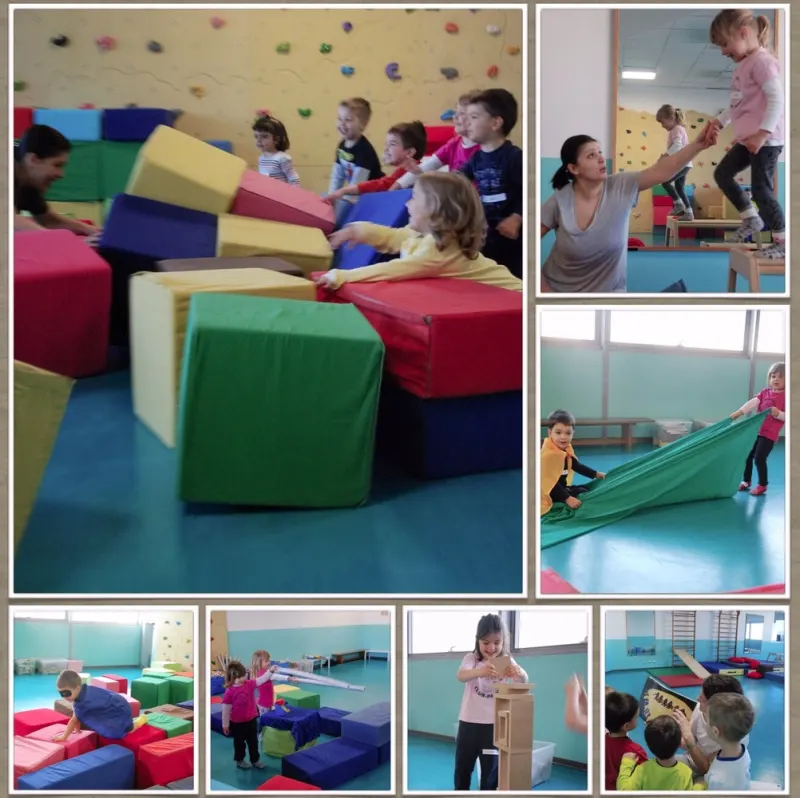
The psychomotor space is organized into three functional areas:
Sensory-motor space - Jumps, climbing, balance, rolling, and spontaneous movement, to promote the maturation of bodily expressiveness and the construction of identity.
Symbolic play space - Constructions, transformations, pretend play, and symbolic use of materials, to support affective and relational expression.
Representation space - Drawing, constructions, and modeling, to facilitate processes of symbolization, decentering, and verbalization of experience.